
This week, my husband and I celebrate 25 years of marriage! Firstly, we are extremely grateful to God, because we truly believe He is the glue that holds our lives together.
The Joys and the Hard Stuff
We have shared some wonderful experiences together. The birth of our daughters was pure joy, especially after struggling to conceive and experiencing high-risk pregnancies. Other highlights include a 10-day road trip along the west coast of the USA in a convertible Mustang, and the incredible holidays we’ve enjoyed thanks to the travel industry. The list is long!
Conversely, we lost my husband’s brother unexpectedly, navigated health issues and work struggles, and endured long periods of separation due to my husband’s travel. Any pilot’s wife will tell you that it’s always when they’re away that the kids get sick or things go wrong at home. Doctors told us that it was unlikely we would have children naturally and that pregnancy would be risky.
Marriage Is Not 50/50
My husband is often asked by younger colleagues what makes a marriage work. He tells them people have it wrong if they think marriage is 50/50. He believes marriage is about giving 100% all the time, but that doesn’t mean it’s easy. Life throws curveballs, we get stressed, we get tired, and life gets hard, but we aim to give 100% most of the time.
Here’s what I know helps us. When we argue and tempers have cooled, we are quick to apologise and talk things through. We don’t leave unfinished business simmering. We don’t bring up the past. We forgive without harbouring grudges. We challenge each other to be better without trying to change who the other person is. I can honestly say he is my biggest cheerleader, my best friend, and the person who always has my back.
Discovering Our Brain Profiles
When I became a brain profile practitioner, the very first thing I did was ask my family to complete their brain profiles. It has been a complete game changer in how we communicate, not only in our marriage, but also with our children and between our children.
These are our Brain Profiles:
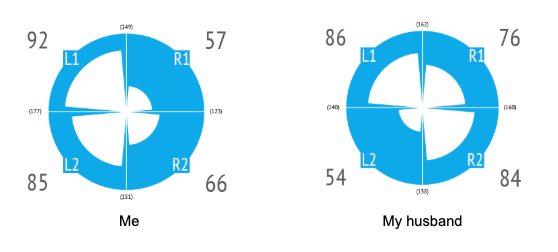
A quick glance at our profiles will tell you that we are quite different. Both of our highest preference scores are in L1, analytical thinking. Perfect, you might think. My second-highest score is in the L2 quadrant as an organiser, which happens to be my husband’s lowest score. He has a very high R2 score as an empathiser, while my R2 score is average. I am a higher socialiser than empathiser, while he is a high empathiser and low socialiser.
On the surface, we agree on most things. We have always been aligned on how we raise our children, our goals, life choices, and future plans. We both view life as realists through our strong L1 preference. When it comes to communication and day-to-day life, however, we can have serious challenges.
Learning to Communicate Differently
Now imagine this in a marriage. I am a strong organiser, a direct communicator, and I can get overly focused on details. If I know what needs to be done, I do it, and if I have something to say, I tend to say it very directly. My husband communicates more sensitively, sees the bigger picture, and is not an organiser. By comparing and discussing our brain profiles, we have changed the way we communicate.
My husband now speaks more directly to me and has learned to be more assertive in expressing his feelings or what he means, rather than skirting around issues. I, on the other hand, have had to become far more aware of how I deliver my frustrations, choosing a gentler and non-accusatory tone. Knowing that my husband is sensitive to tone and body language, I’m now far more intentional when having serious discussions, so he can receive what I mean without becoming defensive. This allows us to have constructive conversations rather than arguments. This is very much a work in progress.
Working With Each Other’s Strengths
My husband naturally prioritises people and their feelings. He never wants to hurt anyone and is always kind and considerate. He treats everyone the same, from senior management at work to the security guards at my daughter’s school, all of whom know him and respect him for it. However, when it comes to difficult conversations or making a complaint, he can struggle to be direct and succinct, which sometimes leaves things open to misinterpretation. If he isn’t clear with me, I don’t always understand what he truly needs or wants.
His lack of organisation can still drive me crazy. Through brain profiling, I finally understood why this doesn’t come naturally to him. Because it is my strength, I’ve put systems in place to support us both, like a shared calendar with reminders that the whole family uses. I’ve also learned to be more patient when he forgets things, like a child’s music lesson. At the same time, he has taken on some of the admin tasks, so I don’t feel like I’m carrying everything alone. I used to feel burnt out doing it all, especially while working full-time and managing his travel schedule.
What 100% Looks Like
Doing our brain profiles has changed the way we communicate and how we approach challenges. It has made serious conversations easier and helped us understand why what we say affects behaviour. We don’t always get it right, especially when we’re tired or emotional, but it has given us the ability to pause and assume positive intent. We can say, “Okay, he didn’t mean that. We’ll talk about this later.”
I am a terrible morning person. Please speak to me as little as possible until I’ve had a chance to gather my thoughts and prepare my brain for the day, usually after a coffee. He knows this about me. So we are gentle with each other. I carry more slack when he has only slept a few hours after a flight. I do more with the kids and around the home so he doesn’t have to. When I’ve had a rough day, he steps in, makes dinner, takes care of the kids’ needs, and covers for me so I can have some space.
The Biggest Takeaway
Like us, our marriage is not perfect. But every day, we choose each other. We try hard to prioritise our relationship, listen well, and communicate in a way the other person can receive. We work with each other’s strengths and support one another’s less preferred thinking styles. That is what giving 100% every day looks like.
The biggest takeaway for us has been this: understanding how your brain, and the brain of the person you love, is wired changes everything. Brain profiling has given us a shared language, reduced unnecessary conflict, and helped us communicate with more empathy and clarity.
If you would like to strengthen communication in your marriage, family, or workplace, brain profiling is a powerful place to start. If you’re curious about how a brain profile could support your relationships, I would love to help.
Reach out, start the conversation, and take the first step toward communicating with greater understanding and connection.